India's first AI-powered platform dedicated to preserving and empowering tribal languages
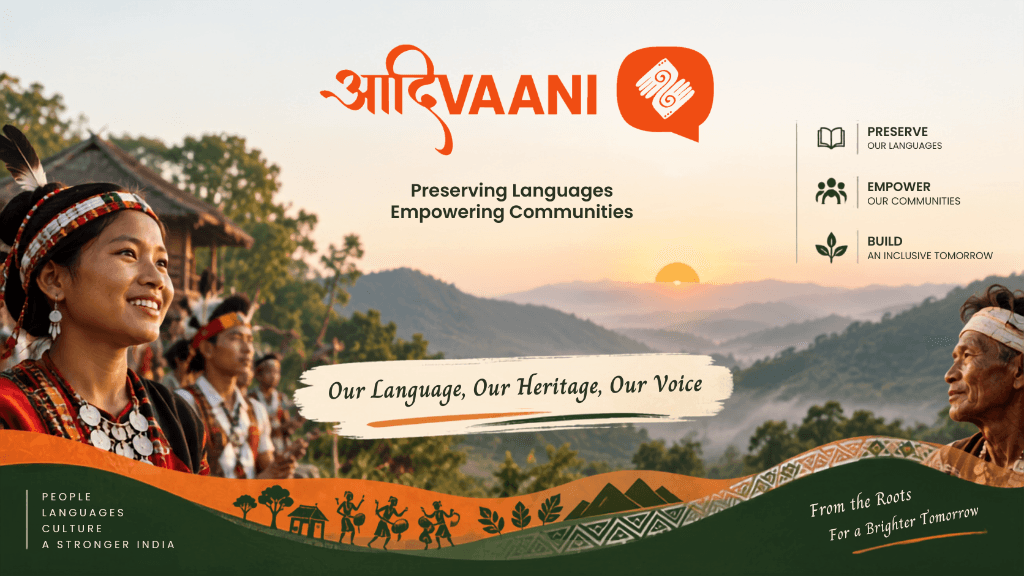
Our Language, Our Heritage, Our Voice
Translate the web. Connect with tribal languages.
Translate entire websites into supported tribal languages directly from your browser with Adi Vaani.
Research and resources related to Adivaani and tribal language technology.
Pooja Singh, Sandeep Kumar
Community-curated benchmark dataset and evaluation suite for machine translation into indigenous tribal languages.
Pooja Singh, Ka'ab Shahid, Saurabh Chauhan, Nishant Agnihotri, Sandeep Kumar
Documentation-oriented Automatic Speech Recognition benchmark for endangered tribal languages.
In collaboration with our consortium partners
Tribal Research Institutes Involved
We solve data scarcity by collaborating directly with tribal communities, elders, and linguists.
Every translation is refined and validated through community collaboration and linguistic expert review.
Our tool is built by and with the community, ensuring it is relevant, respectful, and genuinely useful.
Backed by leading institutes, Adivaani is not just a tool — it is a movement to preserve and empower.
Bhili is one of India's most ancient tribal languages, spoken predominantly across Madhya Pradesh, Gujarat, Rajasthan, and Maharashtra.
It preserves folklore, customs, oral traditions, agricultural wisdom, forest practices, and cultural festivals like Bhagoria and Gavari.
Santali is the mother tongue of the Santhal tribe and belongs to the Munda sub-family of Austroasiatic languages.
As one of India's scheduled languages, Santali holds deep cultural, social, and political importance.
Mundari belongs to the Austro-Asiatic Munda language family and is spoken mainly in Jharkhand, Odisha, Chhattisgarh, and West Bengal.
It is central to rituals, festivals, folklore, songs, and indigenous knowledge systems.
Gondi is a Dravidian language spoken across central and southern India by the Gond community.
It embodies the traditions, folklore, wisdom, identity, and resilience of the Gond community.
Garo is a Tibeto-Burman language spoken primarily by the Garo community in Meghalaya, with speakers also found in parts of Assam and neighboring regions.
It preserves Garo oral traditions, folklore, songs, traditional knowledge, festivals, and the cultural identity of one of Northeast India's major indigenous communities.
Kui is a South-Central Dravidian language traditionally spoken by the Kondh communities, mainly across Odisha and adjoining areas of central India.
It carries the oral traditions, folklore, songs, rituals, ecological knowledge, and cultural heritage of the Kondh communities.
Kokborok is a Tibeto-Burman language traditionally spoken by the Tripuri and related indigenous communities of Tripura and neighboring areas of Northeast India.
It is a major symbol of Tripura's indigenous identity and preserves traditional stories, songs, customs, folklore, and cultural knowledge.
Betta Kuruba, also known as Betta Kurumba, is a Southern Dravidian language spoken by the Betta Kuruba community in the Nilgiri Hills and adjoining areas of Karnataka, Tamil Nadu, and Kerala.
It preserves the community's oral traditions, forest-based knowledge, cultural practices, folklore, and distinctive identity. The language is considered vulnerable and deserves documentation and revitalization.
Katkari, also known as Kathodi, is an Indo-Aryan tribal language traditionally spoken by the Katkari community, mainly in Maharashtra and in smaller areas of neighboring states.
It preserves the oral traditions, songs, folklore, traditional occupations, forest knowledge, and cultural identity of the Katkari community.
Koya is a South-Central Dravidian language spoken by the Koya community across parts of Telangana, Andhra Pradesh, Odisha, Chhattisgarh, and neighboring regions.
It carries the community's oral traditions, folklore, songs, agricultural and forest knowledge, rituals, and cultural identity.
Thadou Kuki, also known as Thadou or Thado Chin, is a Kuki-Chin language spoken primarily in Manipur and neighboring areas of Northeast India.
It is an important part of Thadou-Kuki cultural identity and preserves traditional stories, songs, customary practices, oral history, and indigenous knowledge.
Tangkhul is a Tibeto-Burman language spoken primarily by the Tangkhul Naga community in Manipur and neighboring areas of Northeast India.
It preserves rich oral literature, traditional songs, folklore, ceremonies, community history, and indigenous knowledge passed through generations.
Chodri, also known as Chaudhari or Chowdhary, is a Bhil language of the Western Indo-Aryan family spoken mainly in Gujarat and neighboring parts of western India.
It preserves the folklore, oral traditions, social customs, songs, traditional knowledge, and cultural identity of Chodri-speaking tribal communities.
Together, these 13 languages represent India's linguistic diversity and the voices of millions who have been historically underrepresented.
Translating official schemes and documents directly into tribal languages.
Speech-to-speech and OCR tools for clear healthcare communication.
Generating bilingual primers and digital learning resources.
Transcribing and translating oral traditions, songs, and stories.
Helping tribal communities participate fairly in markets and the digital economy.
To bridge the digital divide for India's tribal communities through AI-powered translation technology.
A digitally inclusive India where no citizen is left behind due to language barriers.
Respect, collaboration, authenticity, innovation, and empowerment through digital inclusion.
Tribal languages carry centuries of knowledge, traditions, songs, folklore, and cultural identity.
Adivaani bridges the digital gap by preserving linguistic diversity while enabling practical empowerment.
We are committed to co-creating with tribal communities, ensuring authenticity, respect, and acceptance.